|
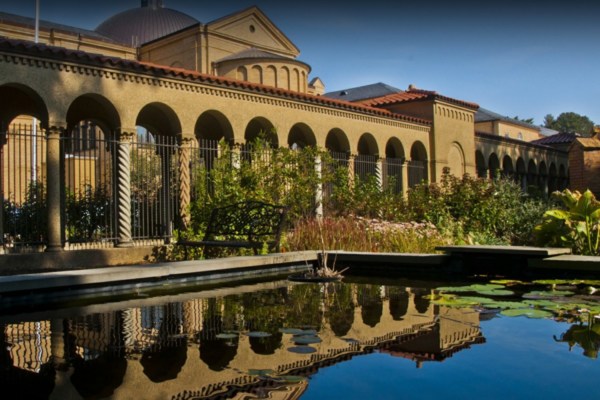
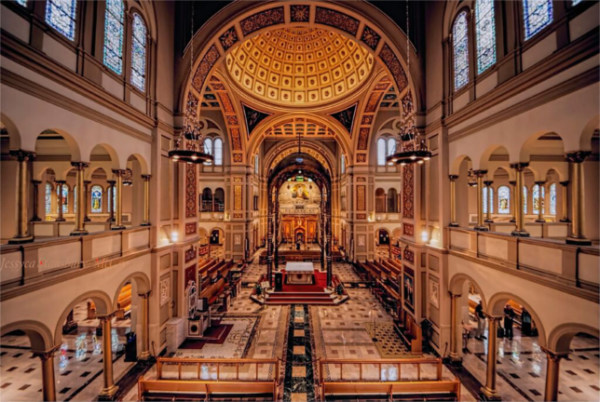
The Memorial Church of the Holy Sepulchre was designed by the Roman architect Aristide Leonori, and built in 1898-99. The floor plan of the church is the five-fold Crusader Cross of Jerusalem, and it is built in the Byzantine style, after the Hagia Sofia in Constantinople (Istanbul), with some modified Romanesque influences. Surrounding the church is the Rosary Portico, with 15 chapels commemorating the lives of Jesus and Mary. Each chapel contains artistic ceramic plaques bearing the Angelic Greeting in nearly 200 ancient and modern languages. The Rosary Portico is reminiscent of the cloister of St. John Lateran in Rome and St. Paul’s Outside the Walls.
The façade of the portico is decorated with early Christian symbols from the Catacombs. Attached to the rear of the church is the monastery, built in the monastic style of the late Romanesque. The meticulously landscaped monastery grounds contain replicas of shrines in the Holy Land, as well as a greenhouse. In the early days of the monastery, the grounds were the site of a small farm, and also included a barn, grain silo, tool sheds and other outbuildings.
Artists and Architects
Over the years, the monastery has had many artists and architects – both religious and secular - who have contributed to the development of the site.
Architects: Aristide Leonori (1856-1928) John Joseph Earley (1881-1945) Brother Cajetan Baumann (1899-1969)
Artists: Charles Bosseron Chambers (1882-1964) Charles Svendsen (1871-1959) Brother Leoni Bracaloni (1885-1975)
|